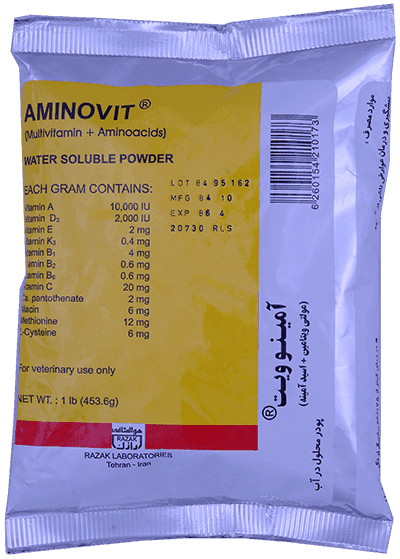
Aminovit (Multivitamins | 100g | 1kg)
V-X2BZK · No reviews yet
We offer Aminovit which is highly concentrated with vitamins and essential amino acids required for boosting egg production and eggs size.
- It is suitable in cases of dehydration, hepatic intoxications, hypoproteinemia, also to restore ionic balance. In diarrhea, anemia, and neuropathies.
- In cattle and pigs, it is obtained a better production with greater fertility and better crias. In dairy cows, it increases the production and in meat animals, you get more meat and less fat.
- The offered product helps livestock recover faster from diseases, boosting their immune status.
- It Increases appetite and reduces stress associated with transportation, vaccination, debeaking, heat, etc.
- Check for updates of the actual packaging design of this product.
Place an order now!
1633
UNCATEGORIZED
Multivitamins
₦ 1,450
Product description
Aminovit
We offer Aminovit which is highly concentrated with electrolytes, vitamins, and essential amino acids required for boosting egg production and egg size.
- The offered product helps livestock recover faster from diseases, boosting their immune status.
- It Increases appetite and reduces stress associated with transportation, vaccination, debeaking, heat, etc.
Indications for using Aminovit
It is indicated for use in the following cases:
- Prevention and treatment of dehydration, unbalance of electrolytes, insufficiencies of protein due to high-degree fever, vomit, severe diarrhea.
- Improvement of animal health in convalescence, anemia, stress, depression, emaciation, chronic diseases, or acute diseases.
- Stimulation of appetite; Improvement of feed efficiency; Promotion of body weight gains.
Dosage and administration
- Poultry:
- Prevention: Add 1g to 1-liter drinking water (a full sachet to 450 liters of drinking water).
- Treatment: Add 5g to 1-liter drinking water (a full sachet to 90 liters of drinking water).
- Fish: Add 500g to 1 ton of feed.
Importance of vitamins in poultry production
Vitamins are a group of organic compounds that poultry only require in small quantities, but they are essential for normal body functions, growth, and reproduction. A deficiency of one or more vitamins can lead to a number of diseases or syndromes.
- Vitamin C supplementation is useful when birds are under stress.
- Vitamin A is required for normal growth, reproduction, and maintenance of epithelial cells in good condition (skin and the linings of the digestive, reproductive, and respiratory tracts).
- Deficiency of vitamin A causes nutritional roup, characterized by conjunctivitis, oculo-nasal discharge, and eyelids stuck together with thick exudates.
- Vitamin D3 is required for proper absorption and utilization of calcium and phosphorous, which are required for normal growth, bone development, and eggshell formation.
- The deficiency of vitamin D3 leads to rickets. Birds produce thin-shelled eggs with reduced hatchability, show leg weakness, and penguin-like sitting posture. The beak, claws, and ribs become very pliable.
- Vitamin E is a powerful antioxidant and is important for normal neurological functions. Deficiency leads to encephalomalacia/crazy chick disease, exudative diathesis in young birds, muscular dystrophy seen more frequently in older and mature birds.
- Vitamin K is essential for the synthesis of prothrombin, thus it plays an important role in clotting mechanisms and also has a protective effect against coccidiosis.
- Deficiency of vitamin K may cause an increase of blood spots in eggs, hemorrhages in the legs & breast, and failure of blood clotting.
- The B vitamins include vitamin thiamin, riboflavin, niacin, pantothenic acid, pyridoxine, biotin, folic acid, and cyanocobalamin. B vitamins are involved in many metabolic functions, including energy metabolism. A vitamin premix is typically used to compensate for the fluctuating levels of vitamins found naturally in food and to assure adequate levels of all vitamins.
Highlights
Shipping
Local pick-up2 – 4 days
Office pick-up3 days
Product description
Aminovit
We offer Aminovit which is highly concentrated with electrolytes, vitamins, and essential amino acids required for boosting egg production and egg size.
- The offered product helps livestock recover faster from diseases, boosting their immune status.
- It Increases appetite and reduces stress associated with transportation, vaccination, debeaking, heat, etc.
Indications for using Aminovit
It is indicated for use in the following cases:
- Prevention and treatment of dehydration, unbalance of electrolytes, insufficiencies of protein due to high-degree fever, vomit, severe diarrhea.
- Improvement of animal health in convalescence, anemia, stress, depression, emaciation, chronic diseases, or acute diseases.
- Stimulation of appetite; Improvement of feed efficiency; Promotion of body weight gains.
Dosage and administration
- Poultry:
- Prevention: Add 1g to 1-liter drinking water (a full sachet to 450 liters of drinking water).
- Treatment: Add 5g to 1-liter drinking water (a full sachet to 90 liters of drinking water).
- Fish: Add 500g to 1 ton of feed.
Importance of vitamins in poultry production
Vitamins are a group of organic compounds that poultry only require in small quantities, but they are essential for normal body functions, growth, and reproduction. A deficiency of one or more vitamins can lead to a number of diseases or syndromes.
- Vitamin C supplementation is useful when birds are under stress.
- Vitamin A is required for normal growth, reproduction, and maintenance of epithelial cells in good condition (skin and the linings of the digestive, reproductive, and respiratory tracts).
- Deficiency of vitamin A causes nutritional roup, characterized by conjunctivitis, oculo-nasal discharge, and eyelids stuck together with thick exudates.
- Vitamin D3 is required for proper absorption and utilization of calcium and phosphorous, which are required for normal growth, bone development, and eggshell formation.
- The deficiency of vitamin D3 leads to rickets. Birds produce thin-shelled eggs with reduced hatchability, show leg weakness, and penguin-like sitting posture. The beak, claws, and ribs become very pliable.
- Vitamin E is a powerful antioxidant and is important for normal neurological functions. Deficiency leads to encephalomalacia/crazy chick disease, exudative diathesis in young birds, muscular dystrophy seen more frequently in older and mature birds.
- Vitamin K is essential for the synthesis of prothrombin, thus it plays an important role in clotting mechanisms and also has a protective effect against coccidiosis.
- Deficiency of vitamin K may cause an increase of blood spots in eggs, hemorrhages in the legs & breast, and failure of blood clotting.
- The B vitamins include vitamin thiamin, riboflavin, niacin, pantothenic acid, pyridoxine, biotin, folic acid, and cyanocobalamin. B vitamins are involved in many metabolic functions, including energy metabolism. A vitamin premix is typically used to compensate for the fluctuating levels of vitamins found naturally in food and to assure adequate levels of all vitamins.
Highlights
Shipping
Local pick-up2 – 4 days
Office pick-up3 days